Public Discussion of Padepokan Aufklärung VI Highlights Indonesia’s Position Amid American Arrogance and the Global Humanitarian Crisis.
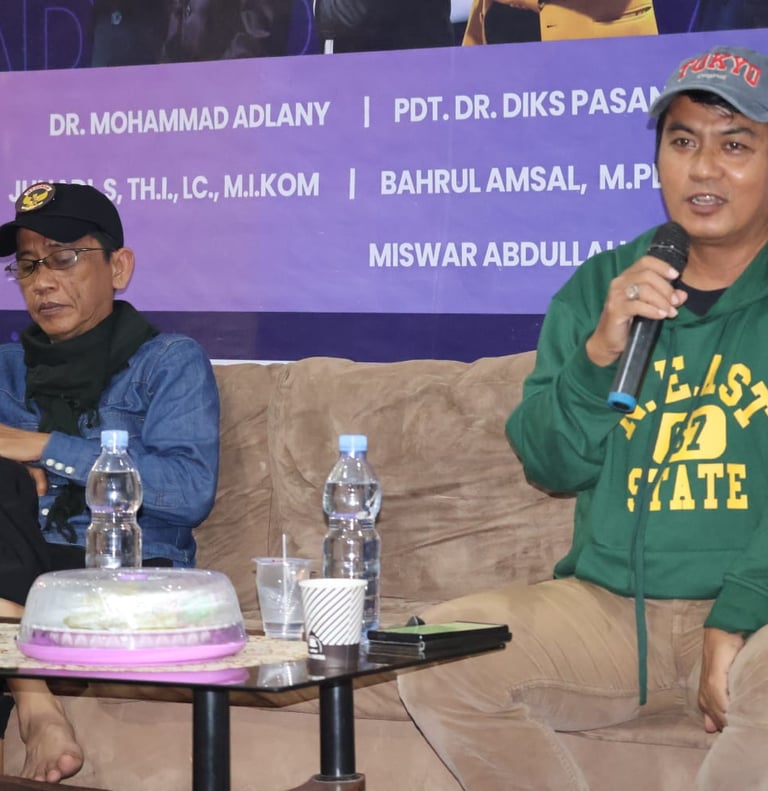
A public forum at Padepokan Aufklärung VI in Makassar examined the role of the United States in global humanitarian crises and questioned Indonesia’s moral and constitutional stance in responding to them. Speakers emphasized Indonesia’s non-aligned principles, its obligation to defend oppressed peoples, and the influence of media in shaping global public opinion.
NEWS & EVENTS
J. Solong (CEIS Makassar Activist)
1/12/20263 min read
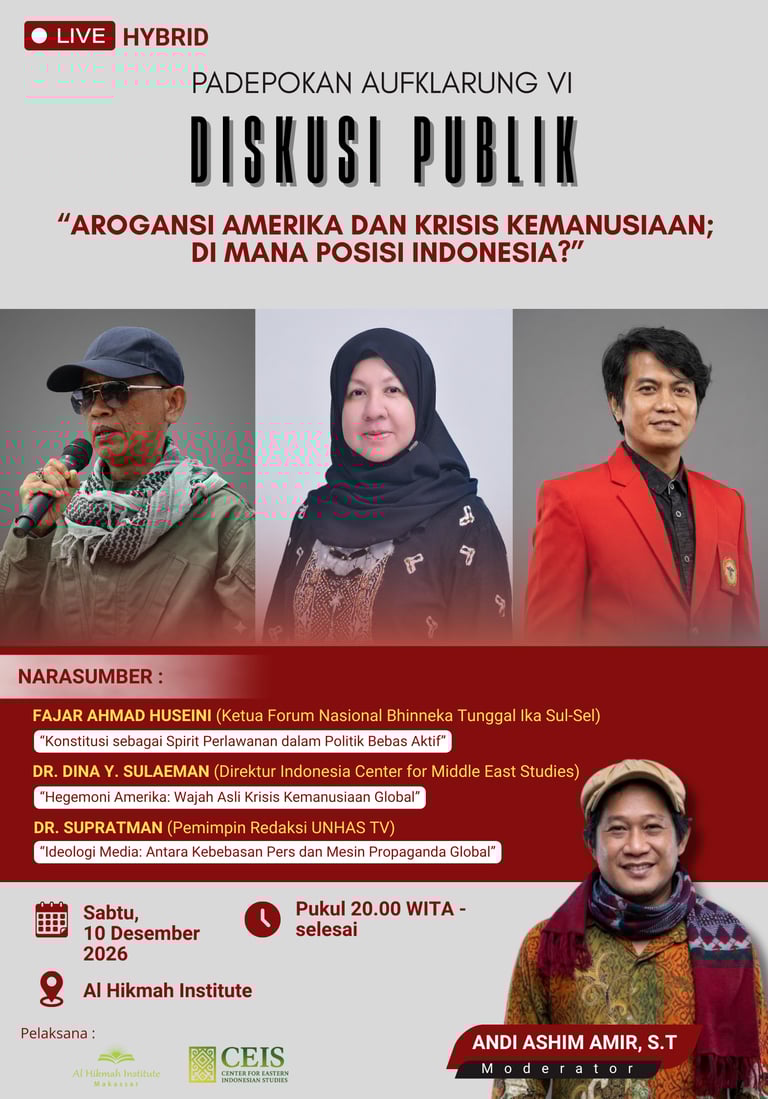
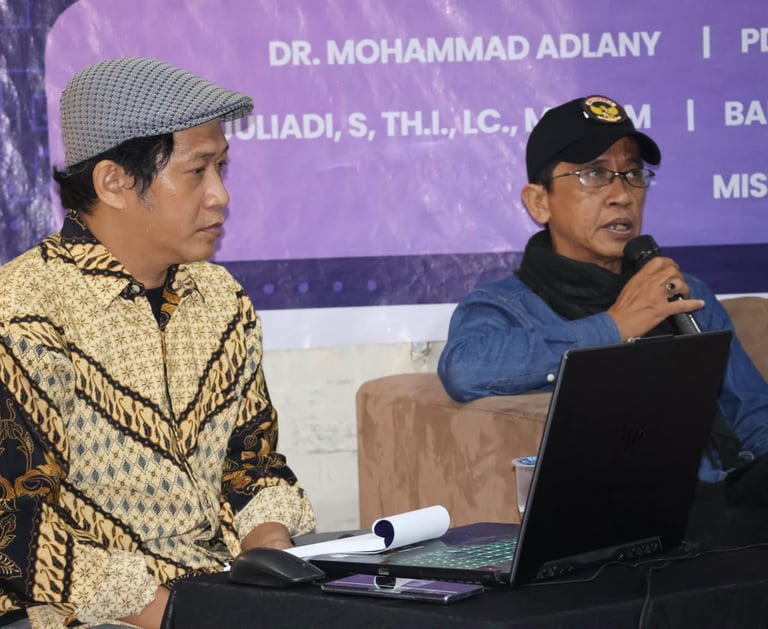
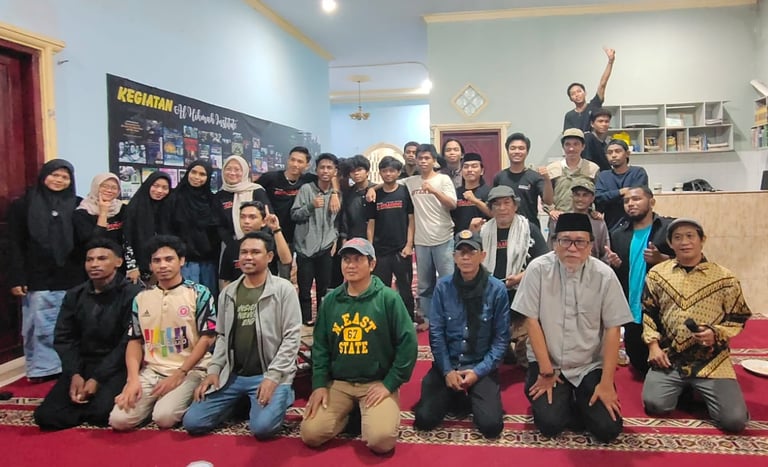
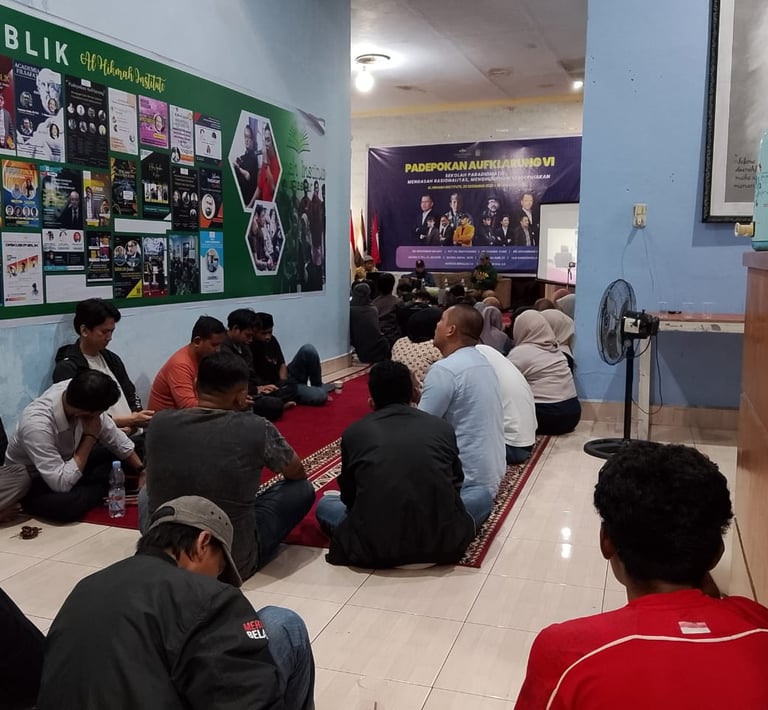
Entering the third week of the Padepokan Aufklärung VI program, Al Hikmah Institute Makassar, in collaboration with the Center for Eastern Indonesian Studies (CEIS), once again held a public discussion on Saturday, January 10, 2026. The discussion carried the theme “American Arrogance and the Humanitarian Crisis: Where Does Indonesia Stand?”
This theme was chosen in response to various humanitarian tragedies occurring in different parts of the world, which are seen as taking place openly with the involvement of the United States. Among the issues highlighted were the ongoing humanitarian crisis in Palestine and the alleged kidnapping of Venezuelan President Nicolás Maduro, which has sparked international condemnation.
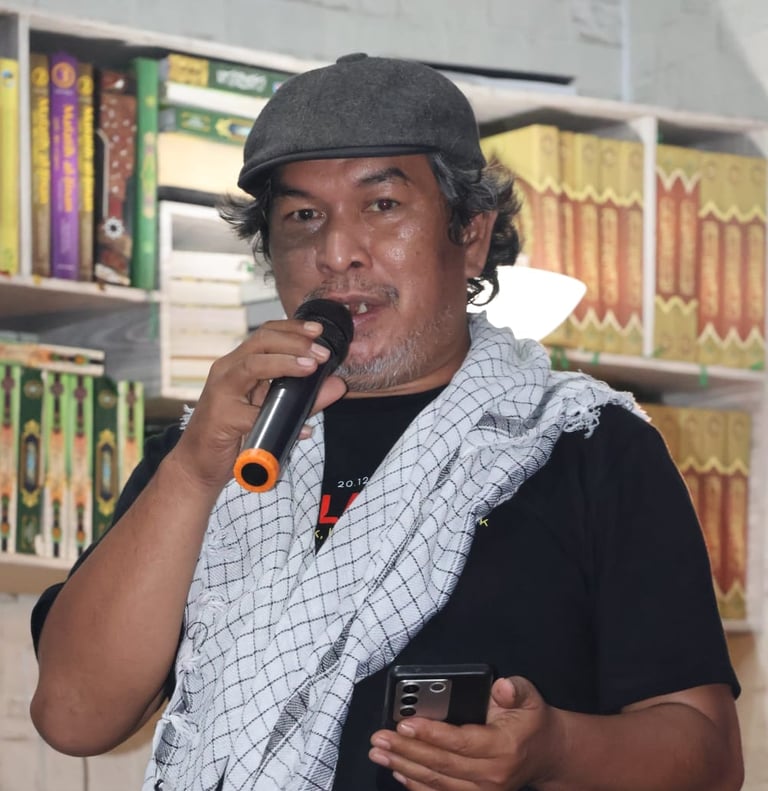
In his opening remarks, the Director of Al Hikmah Institute Makassar, Juliadi Solong, emphasized the importance of making the constitution a shared ethical foundation in addressing global issues. According to him, Indonesia’s stance on international affairs cannot be separated from the mandate of the state’s foundational principles.
Juliadi recalled Mohammad Hatta’s historic speech before the Working Committee of the Central Indonesian National Committee (KNIP), entitled “Rowing Between Two Reefs.” The speech affirmed Indonesia’s position of not aligning itself with the two major global powers of that era: the Western Bloc led by the United States and its allies, and the Eastern Bloc led by the Soviet Union.
“Bung Hatta’s idea shows that Indonesia does not stand between two great powers for pragmatic interests, but stands firmly on principles,” Juliadi said.
He added that defending victims of oppression and resisting all forms of injustice are part of the constitutional mandate, as well as a theological and moral calling for a free nation.
Middle East observer and Director of the Indonesia Center for Middle East Studies (ICMES), Dr. Dina Y. Sulaiman, stated that the United States plays a significant role in various global humanitarian crises, particularly in Palestine and Latin America.
Dina said that genocide in Gaza has been ongoing for more than three years, while efforts by the United Nations to intervene have repeatedly failed due to vetoes by the United States.
She referred to UN reports indicating American economic involvement through Israel’s procurement of F-35 fighter jets, part of the world’s largest arms program involving around 1,600 companies in eight countries, led by US-based Lockheed Martin.
According to Dina, a similar pattern can be seen in Venezuela. She argued that the alleged US actions of invading and abducting President Nicolás Maduro constitute a violation of international law. American interests, she said, are linked to control over natural resources—especially oil—and geopolitical strategies aimed at dominating regions considered strategically important.
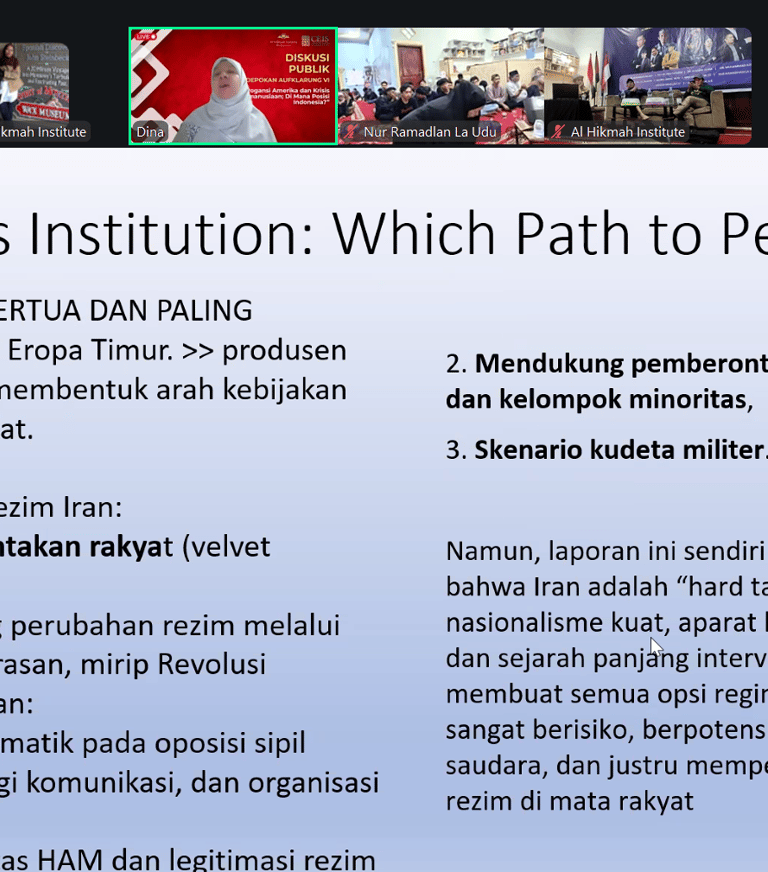
Dina also mentioned pressure on Iran. Quoting the Brookings Institution’s analysis in the document Which Path to Persia, she said there has been discourse about regime change in Iran through human rights issues and political pressure. However, Iran is considered a difficult target due to the rationality of its society and the solidity of its state apparatus.
Regarding Indonesia’s position, Dina assessed that Indonesia belongs to the category of a non-aligned middle power and possesses historical legitimacy among Global South countries, including through its participation in BRICS. Nevertheless, she observed a reluctance by the government to take a firm stance against the West.
“Yet normatively, our constitution is clear: colonialism in any form must be abolished,” Dina said.
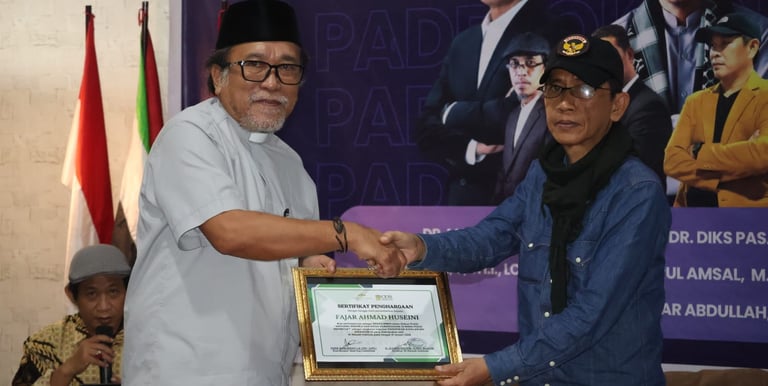
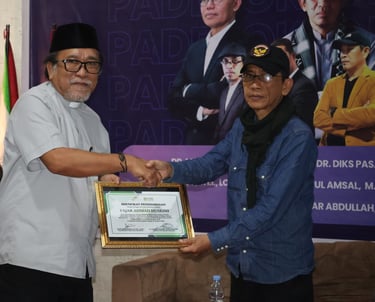
The Chairman of the National Forum for Bhinneka Tunggal Ika of South Sulawesi, Fajar Ahmad Husein, stressed that safeguarding the dignity of the constitution is the duty of all citizens and cannot be fully delegated to the government. He noted that Indonesia’s stance on Palestine and American global dominance has led to public dissatisfaction.
“Political and economic dependence makes it difficult for the government to take a firm position in international forums, even though this is mandated by the constitution and the values of Pancasila,” he said.
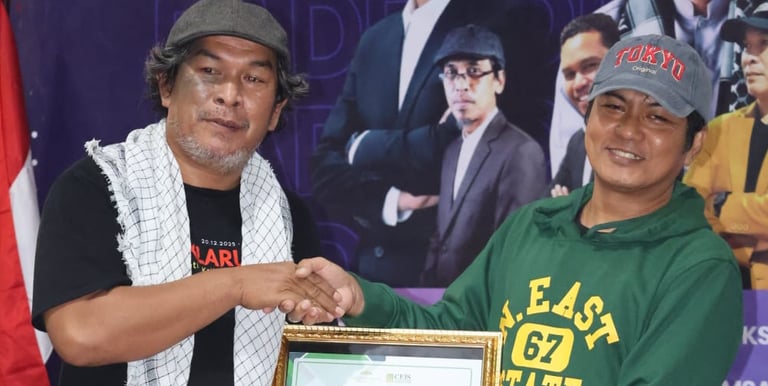
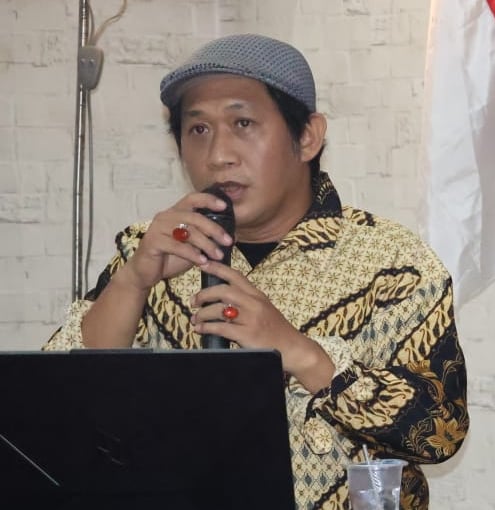
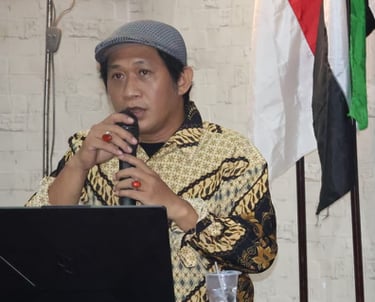
Meanwhile, Dr. Supratman, an academic at Hasanuddin University and Editor-in-Chief of UNHAS TV, highlighted the role of media in global propaganda. According to him, the media does not merely convey information, but also shapes agendas and public perspectives.
In the era of disruption, Supratman said, virality often defeats truth, especially through social media, which plays a major role in shaping global opinion. This condition is exploited by global political actors and strengthens international polarization.