
Politics of Fear: War, Nukes, and Global Injustice
Explores global inequality through the lens of Iran’s nuclear issue, critiquing the double standards of world powers in determining who can possess nuclear weapons. It unveils how collective fear is shaped by power and narrative.
VOICES FROM THE EAST
Sitti Nurliani Khanazahrah, M.Ag. (Founder of House of Philosophical Studies, Makassar & Lecturer at UIN Alauddin Makassar)
6/24/2025
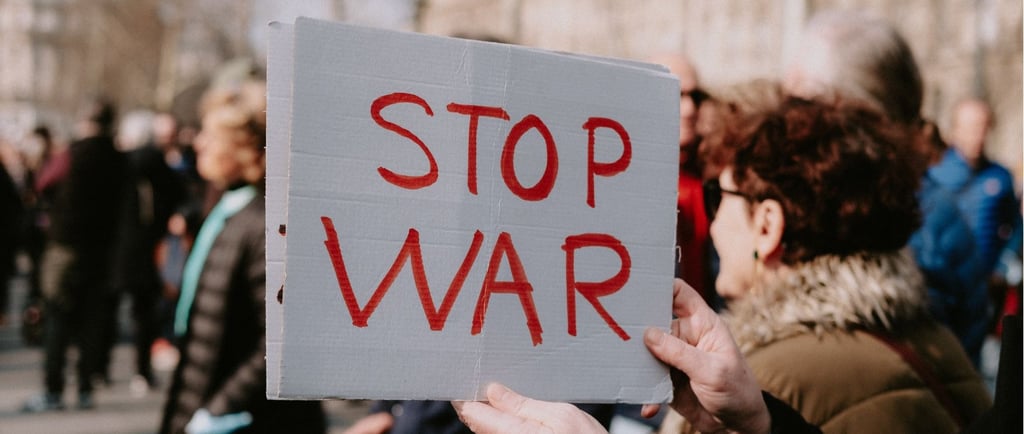
This morning, Tuesday, June 24, 2025, I gazed at my social media feed, increasingly filled with news of war. Among the many headlines, one caught my eye: “Iran enriches uranium close to weapons-grade levels.”
The news passed by swiftly, drowned in posts about the weather, rising food prices, and political updates. The world now seems divided in two—those who go about their daily struggles, and those who, whether in boardrooms or military bases, are deciding the fate of humanity.
Yet for me, the news left unease—not because of Iran’s uranium enrichment, but because of the world’s selectively panicked response. Major powers condemned it. America voiced strong disapproval. Israel issued threats. And the world, accustomed to a one-sided narrative, once again accepted the idea that nuclear weapons in Iran’s hands are a threat, while the hundreds of nuclear warheads stored by the U.S., Russia, France, and Israel seem to stir no global conscience.
It reeks of hypocrisy. Why is the world so adamant that Iran should not have nuclear weapons while other nations are allowed to possess them? The honest answer might be that the world is simply unjust. But deeper than that, the world may now be in a new landscape of warfare—where nukes are just one of many tools used to maintain hegemony.
The Non-Proliferation Treaty (NPT), established in 1968, supposedly provides a legal framework for regulating nuclear weapons, based on three pillars: non-proliferation, disarmament, and the peaceful use of nuclear energy.
At first glance, the NPT seems fair. But a deeper look reveals structural inequality. Only five countries are officially recognized as legitimate nuclear powers—namely the U.S., Russia, the UK, France, and China. Other countries, including Iran, are prohibited from possessing them—even if they face similar or more severe threats. This isn’t merely about law, but about who gets to make the law.
Michel Foucault (1926–1984) argued that law isn’t a neutral institution serving common good but a product of power seeking to preserve itself. Within this framework, the NPT becomes a legal tool that reinforces a power hierarchy—the strong set the rules, and the weak must obey. Iran, being outside this circle of power, is thus scapegoated in global security discourse.
Since the 1979 Revolution, Iran has positioned itself as a challenger to Western dominance—rejecting U.S. control, supporting resistance movements in the Middle East, and fiercely opposing Israel—a country believed to possess nuclear weapons but never subjected to international inspection. When Iran enriches uranium, the West sees it not as a lawful act under the NPT’s peaceful use clause, but as a looming threat.
In reality, uranium enriched to 3–5% is commonly used for power plants. The world only panics when Iran enriches it to 20%, 60%, or close to 90%—suggesting a catastrophe is near. But if the goal was truly a bomb, why hasn’t Iran made one? Why are its facilities still under IAEA supervision? Iran may be treading a gray area, but it’s that same gray zone where powerful nations build their dominance.
Meanwhile, the U.S. modernizes its nuclear arsenal without public oversight, and Israel’s nuclear weapons remain untouched by international inspectors. Suspicions against Iran often stem more from political bias than technical evidence. The core issue isn’t about uranium or bombs—it’s about who is allowed to control the rules, and who must comply.
To understand Iran, one must also consider its energy reserves and strategic location in the Persian Gulf—a region that powers the global economy and military. Oil and gas here are not just economic resources, but strategic assets. Thus, suspicion towards Iran is often entangled with fears of losing access to these resources.
Modern warfare no longer relies solely on armed attacks. Economic sanctions, technology embargoes, trade restrictions, and media propaganda have become effective weapons in bloodless wars. Iran has long been a target of such warfare—not simply for uranium, but for its refusal to bow to global subjugation.
In today’s media-saturated world, Iran is also a victim of narrative war. The West paints it as radical and chaotic, while the abuses of its allies—like Saudi Arabia’s deadly airstrikes in Yemen—go largely uncriticized.
This reveals another face of modern war—fought through discourse, public opinion, and manufactured fear. Fear of Iran is the product of a long symbolic process—not just a technical threat.
Frantz Fanon (1925–1961) called this moral colonialism, where the West sees itself as more civilized and thus more entitled to hold destructive technology. Nuclear weapons are not merely military devices, but symbols of who gets to control the world’s destiny. So, the question about Iran isn’t only legal—it’s existential: who gets to shape the future, and who must remain silent?
In the eyes of the global West, especially toward the Islamic world, the East is seen as wild and unstable. Like a patriarchal view of women—emotional and irrational—it must be controlled. Iran, in this lens, becomes the rebellious woman who must be subdued. The issue isn’t just nukes—but how a region, culture, and belief system are placed within a masculine, exclusive global order.
So when we ask who deserves to hold the doomsday button, the answer seems to lie with those who have military power, a seat at the UN Security Council, and control over global economics. But this is perhaps the greatest irony: that the fate of humanity rests in the hands of a few nations who can’t even account for the morality of their own weapons. Hiroshima and Nagasaki should be eternal reminders that WMDs are not protectors—they are curses.
Jalaluddin Rumi (1207–1273) once wrote, “The world is not ruined by lack of truth, but by too many lies believed as truth.” Perhaps this is today’s biggest lie: that security can be maintained through mass destruction, that atomic bombs can bring peace, and that some nations are more entitled to wield them than others. But I believe this world is not safe—it’s fragile, where peace is guarded by fear instead of trust.
So perhaps, we should not be afraid of who enriches uranium, but be more wary of who fears losing control of the world. Because in a world full of inequality, weapons aren’t just about destruction—they determine who gets to survive. Iran, with all its complexity, is a mirror reflecting global injustice. It reminds us that as long as inequality persists, we are all living under a greater threat than just nuclear weapons.