Pancasila and the Challenge of Corruption: Reflections from a Dialogue Space
A reflective dialogue on the values of Pancasila and the challenges of corruption in Indonesia, sparked by the screening of the documentary Pancasila Is Me. Academics and participants explored the philosophical meaning of Pancasila, the role of youth, and the importance of grounding Pancasila in daily life.
NEWS & EVENTS
J. Solong (CEIS Makassar Activist)
6/8/2025
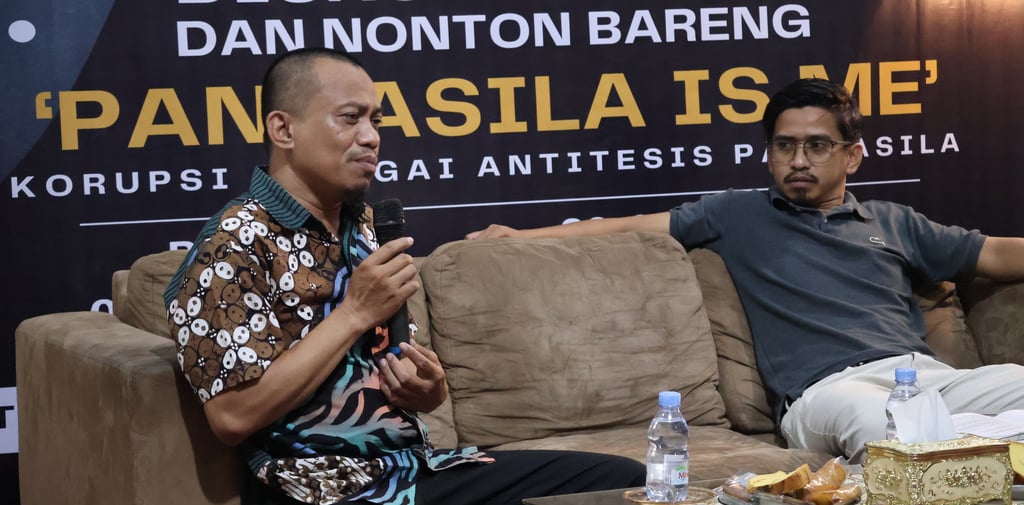
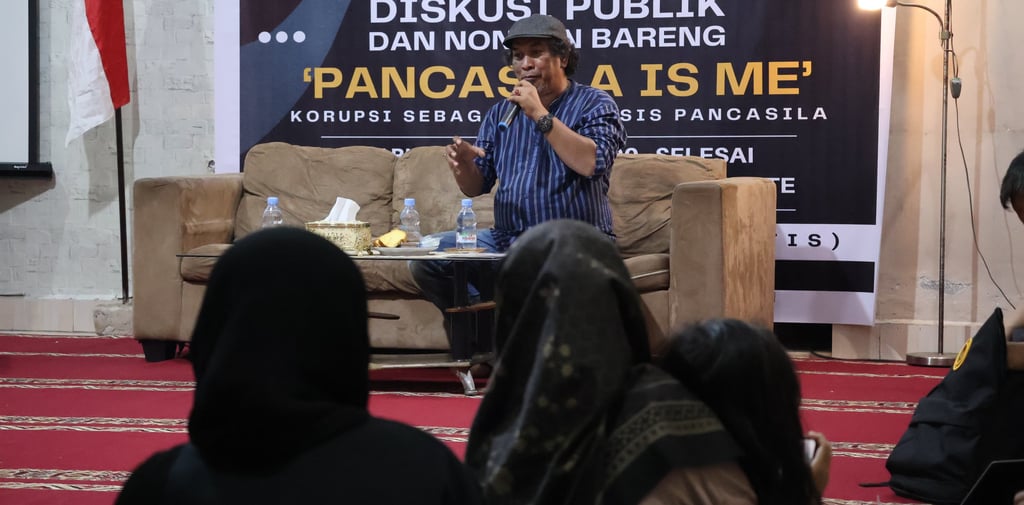
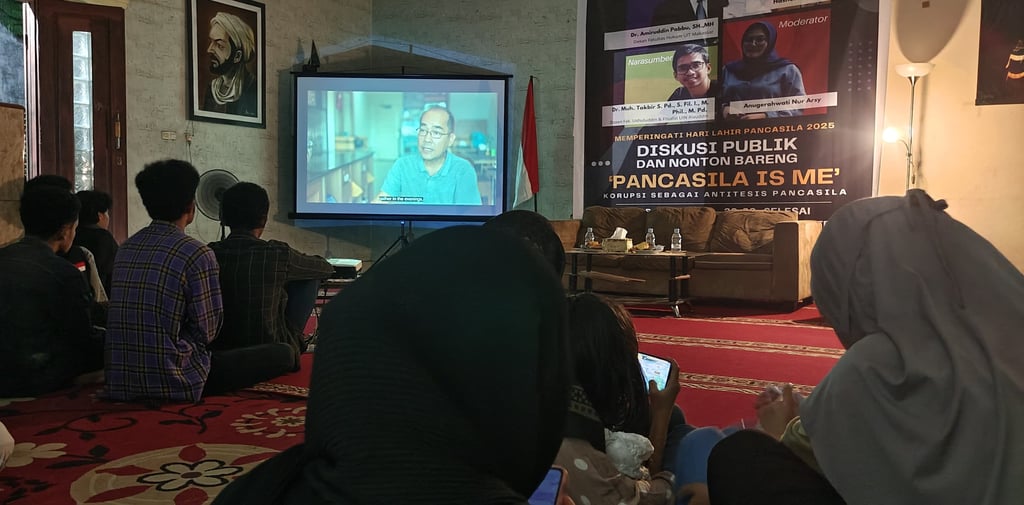
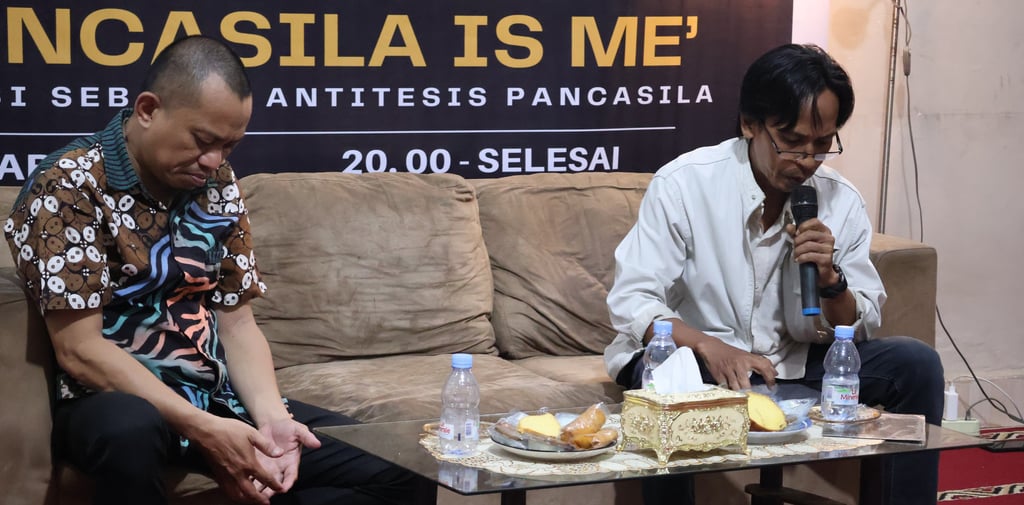
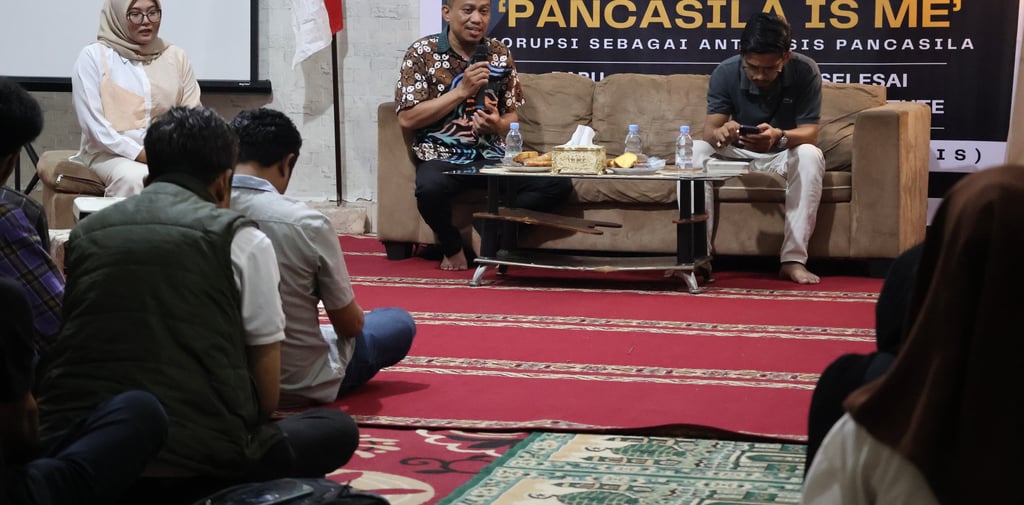
The screening of the documentary Pancasila Is Me, produced by the Indonesia Consortium for Religious Studies (ICRS) in collaboration with Watchdoc and the Pancasila Study Center at Gadjah Mada University, sparked a discussion entitled "Corruption: The Antithesis of Pancasila." The event was held by the Al-Hikmah Institute in partnership with the Centre for Eastern Indonesian Studies (CEIS) at the Al-Hikmah Institute office in Makassar.
In his opening remarks, Juliadi Solong, Director of Al-Hikmah Institute, shared a story about a Christian mother whose son died defending the nation in a Muslim-majority country. When asked about her son's sacrifice, she firmly replied, “My son died for his country, not for his religion.” For Juliadi, this statement reflects the noble values of Pancasila—where love for the nation transcends religious and group identities.
Dr. Amiruddin Pabbu, Dean of the Faculty of Law at the East Indonesia University, served as the first speaker and emphasized that Pancasila is the foundational value of national life. “Pancasila is the foundation of all foundations, a kind of supra-norm in Indonesia’s legal system. In Aristotelian terms, it is the final cause,” he explained.
He added that in the national legal framework, Pancasila occupies the highest position, forming the basis of the Constitution (1945 Constitution) and being further elaborated in laws and regulations. He shared his experience drafting a local regulation on Quran literacy in Makassar, which was delayed for five years. “It was finally passed after we reviewed it and found that it lacked a Pancasila-based foundation. Without the spirit of Pancasila, policy becomes mere legal formality,” he said.
He stressed that as an open ideology, Pancasila continuously evolves with social, legal, and national philosophical dynamics. “Never stop thinking for Indonesia,” he added. He also underlined that Indonesia is an open nation that offers broad freedom of expression—something still considered a luxury in many countries, including the United States.
The discussion intensified when Dr. Muhammad Takbir, fondly known as Abi, a young academic from the Faculty of Philosophy at UIN Alauddin Makassar, spoke as the second speaker. He encouraged participants to revisit Pancasila reflectively and critically. In response to slogans like “Pancasila Is Non-Negotiable” or “Pancasila Is Me,” Abi offered a deeper philosophical approach.
He shared his experience as an undergraduate in Yogyakarta. “I once spoke on RRI Jogja representing students from Eastern Indonesia. When asked about Pancasila, I replied: Pancasila felt distant and foreign to us. If someone had exchanged it for yellow rice back then, I might have accepted. But insult Aru Palakka or one of our ethnic groups, and we would get angry,” he said. For Abi, this illustrates how Pancasila has not yet become a deeply rooted lived consciousness.
He also reminded participants of Revoloesi Pemoeda: Japanese Occupation and Resistance in Java by Benedict Anderson. Anderson concluded that Indonesia’s revolution was a youth revolution. To inspire participants, Abi provocatively said, “Back in 1945, youth gave birth to a new Indonesia. Today, revolutions still beget revolutions, and don’t expect the old to do it. Revolution is the domain of the youth—they are the ones with vision.”
Abi also invited participants to re-explore the history of Pancasila’s formulation, including the dialectical dynamics among the nation’s founders. “Don’t just memorize it; understand the context and intellectual process behind it,” he urged.
His perspective aligned with Ir. Soekarno’s speech on June 1, 1945, in which he described Pancasila as a philosophische grondslag or a living philosophical foundation. Soekarno asserted that if Pancasila were to be distilled into a single word, it would be gotong royong (mutual cooperation). In this spirit, corruption is a betrayal of solidarity and social justice.
The event concluded with a poem reading titled “Pancasila, I Am Yours” by Hasnulir Nur, who also recited it. The poem offered a philosophical reflection and social critique of how Pancasila’s values are practiced amid inequality, corruption, and betrayal of the nation’s ideals.
Through metaphorical and spiritual rhythm, the poem invited people to embrace Pancasila not merely as a memory, but as a living, breathing part of daily life.