Padepokan Aufklärung VI: Nurturing Reason and Cultivating Students' Consciousness
Padepokan Aufklärung VI is an intellectual and spiritual short course initiated by Al-Hikmah Institute Makassar as a response to the growing literacy and epistemological crisis among university students. The program aims to cultivate critical reasoning, philosophical depth, and a substantive theological awareness grounded in social justice.
KNOWLEDGE PRODUCTION
Siti Asma Ahmad (Al Hikmah Institute Fellow)
1/16/2026
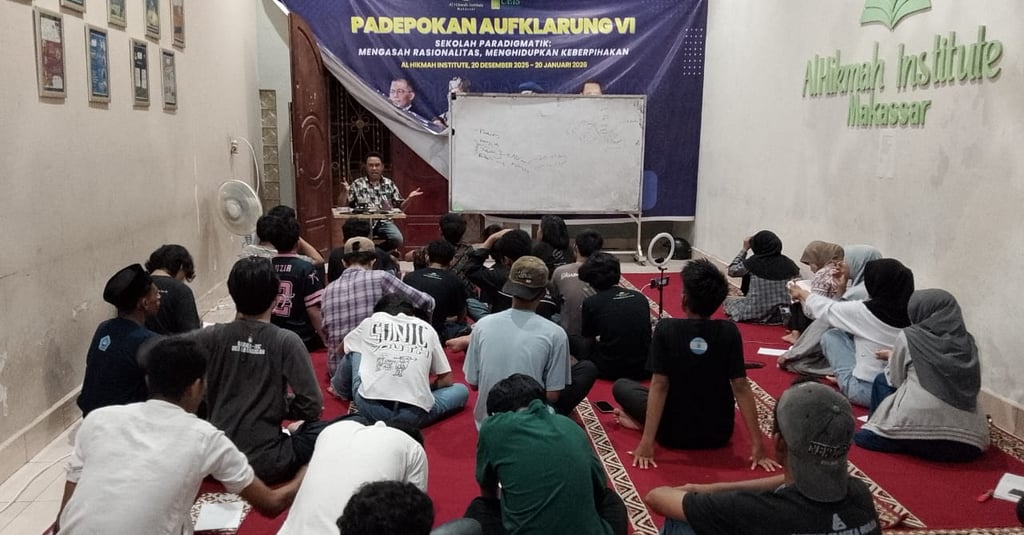
During the implementation of the Padepokan Aufklärung VI Short Course, the Al-Hikmah Institute Makassar team interviewed Ramadhan La Udu, the Steering Coordinator and a lecturer on Contemporary Theology in this annual program.
Ramadhan La Udu, widely known as Ragen, is a mentor and educator at Al-Hikmah Institute Makassar. He is also actively involved in various intellectual discussion forums and cadre development programs, particularly at National Level II Training (LK II Nasional) within the Himpunan Mahasiswa Islam (HMI) across different regions. Currently, Ragen is pursuing his master’s degree (S2) at UIN Alauddin Makassar.
Padepokan Aufklärung VI was born out of deep concern over the condition of today’s young generation, which is perceived to be facing a literacy emergency, an epistemological crisis, and an intellectual deficit in understanding social and religious realities. According to Ragen, this short course is an initiative by Al-Hikmah Institute as a non-formal educational institution to help break the stagnation of thinking among students.
“We see a stagnation in the way students think today. Al-Hikmah Institute wants to contribute, however modestly, to reducing the literacy deficit and epistemic crisis,” Ragen explained.
From its first cohort to the sixth, Padepokan Aufklärung has consistently upheld the spirit of Aufklärung or enlightenment. However, Ragen emphasized that the enlightenment referred to here is not the Western modernist concept that negates religion.
“The Aufklärung we mean is an intellectual and spiritual enlightenment in balance. Intellectuality without spirituality becomes dry, while spirituality without intellectuality risks producing dogmatic attitudes,” he said.
This spirit is implemented in the participants’ daily activities through strengthening critical thinking skills while simultaneously cultivating spiritual awareness.
The curriculum of the short course is structured and progressive, starting from logic, epistemology, Western philosophy, Islamic philosophy, to classical and contemporary theology. According to Ragen, this approach stems from the awareness that social change is only possible when young generations are freed from fallacious ways of thinking.
“Logic and epistemology are the foundations. As Kang Jalal once said, social change begins with the freedom of thought among the youth. Therefore, logic must be reinforced by philosophy and theology,” he explained.
Through comparative studies of Western and Islamic philosophy, participants are invited to understand two major intellectual traditions of the world. Theology is presented not merely as a set of normative doctrines, but as a contextual and grounded paradigm of thinking.
As a theology lecturer, Ragen sees the main challenge faced by participants not in their lack of basic religious knowledge, but in the persistence of formalistic religious patterns.
“Many practice religion normatively, but values of justice and awareness of the Hereafter have not yet been deeply internalized,” he said.
Therefore, the learning approach focuses on awakening substantive consciousness. Religion, according to Ragen, should be reflected in social sensitivity.
“If someone claims to be religious but is not moved by injustice or by people suffering from hunger due to an unjust system, then there is a problem in the way they practice their religion,” he asserted.
The theological discussions at Padepokan Aufklärung VI were intense and dialogical. Participants came from diverse backgrounds, ranging from religious families and Islamic universities to those who practice religion in a more modest manner.
The theological issues discussed often challenged long-held perspectives, especially when religion was introduced through a rational approach.
“Some participants were surprised to realize that religion is not only understood textually, but also rationally. From there emerged a new awareness to continue learning,” Ragen noted.
As the Steering Coordinator, Ragen hopes that this short course will foster a sustained learning spirit, strengthen intellectual capacity, and deepen the spiritual lives of the participants. Meanwhile, as a theology lecturer, he hopes participants will come to understand religion in a substantive way.
“Religion is never far from our daily lives—in our relationship with ourselves, our parents, society, and even the state,” he concluded.