
Padepokan Aufklarung; Nurturing Students' Critical Reasoning Amidst the Onslaught of the Digital Age
Highlights the urgency of philosophy in nurturing students' critical reasoning within the digital era, as reflected in the Padepokan Aufklärung VI short course organized by Al Hikmah Institute Makassar and CEIS. Through an interview with Rev. Dr. Diks Pasande, an interfaith thinker and instructor of Western Philosophy.
NEWS & EVENTS
Siti Asma Ahmad (Al Hikmah Institute Felow)
1/10/2026
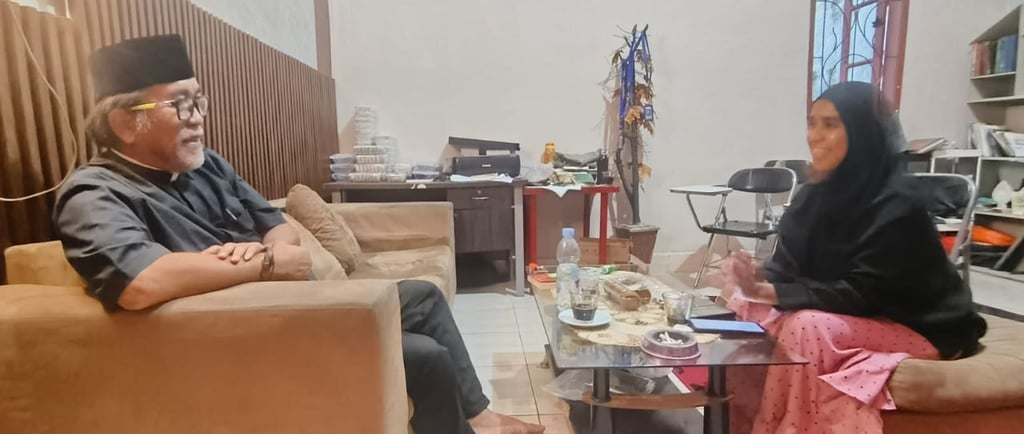
Amidst the swift current of digitalization shaping the mindset of the younger generation, the challenge of nurturing students' critical reasoning is becoming increasingly urgent. Social media algorithms, floods of information, and the offerings of global ideologies often arrive without adequate space for reflection. In this context, philosophy rediscovers its relevance as an instrument of intellectual liberation.
This issue came to the fore during the implementation of Padepokan Aufklärung VI, a 30-day short course on critical thinking organized by the Al Hikmah Institute Makassar in collaboration with the Center for Eastern Indonesian Studies (CEIS). This short course was attended by students from various social backgrounds, disciplines, and schools of thought. In between activities, Siti Asma Ahmad (Al Hikmah Institute Team) had the opportunity to interview Rev. Dr. Diks Pasande, M.Th on Thursday (Jan 8, 2025).
In the interview, Rev. Dr. Diks Pasande—familiarly addressed as 'Pace' Diks—emphasized that the teaching of philosophy is actually becoming increasingly contextual amidst the domination of a digital culture that is entirely practical. "Reviving the tradition of philosophy and critical culture today is indeed full of challenges. However, therein lies its beauty," said Diks when met during a break in the activities.
According to Diks, philosophy has a responsibility to simplify complex problems so they can be understood by all circles. "If philosophy fails to be understood, the error lies not with the participants, but with the way we deliver it," he said.
Reverend Diks is known as a philosophy activist and interfaith thinker. He served as Chairman of the Indonesian Protestant Church of Luwu (GPIL) for the 2004–2009 period, and since 2012 until 2028, he has been active as an ecumenical worker in Germany. In Padepokan Aufklärung VI, he was once again entrusted to teach the material on Western Philosophy.
In his view, several schools of Western philosophy remain relevant for reading the reality of students today. Martin Heidegger's existentialism, for instance, is crucial for understanding human alienation amidst the domination of digital technology. Meanwhile, Michel Foucault's thoughts are considered relevant for dismantling the relations between knowledge, power, and truth within the increasingly massive flow of global ideologies.
"Students today face changes that are very rapid and often beyond control. If not realized, these changes can cause a person to lose their identity and sense of self," said Diks.
Nevertheless, he rejects a pessimistic attitude. According to him, students actually need to be prepared to possess filters and critical awareness. "As Muslim youth, as Indonesians, they must be capable of filtering changes—not being swept away, but also not closing themselves off," he stated.
Diks also noted a tendency toward shifting orientations among students. Some move away from religion and basic values, while others accept global ideologies without critical reflection. "The challenge is how to maintain beliefs and foundational values amidst the bombardment of transnational idealism that often appears very convincing," he said.
He asserted that the primary responsibility of students is the courage to undertake a search for selfhood through reflective questions about the future and idealism. "This is the essence of intellectuality: asking questions, not merely following," said Diks.
Regarding this, he assesses that Padepokan Aufklärung holds a strategic role in nurturing the tradition of critical thinking among students. "Activities like this are important so that students do not experience intellectual inferiority, which ultimately impacts their psychological condition and social attitudes," he concluded.