
Intizhar as an Ethics of Life in the Age of Waiting
Explores the concept of intizhar in Shi'a Mahdawist theology as a lived ethical stance rather than passive waiting. Awaiting the reappearance of Imam Mahdi is presented as an active moral readiness, requiring ethical vigilance, noble character, and a continuous commitment to justice in the present time.
CULTURAL STUDIES
Mohammad Adlany (Lecturer and Researcher at Al Hikmah Institute)
2/4/2026
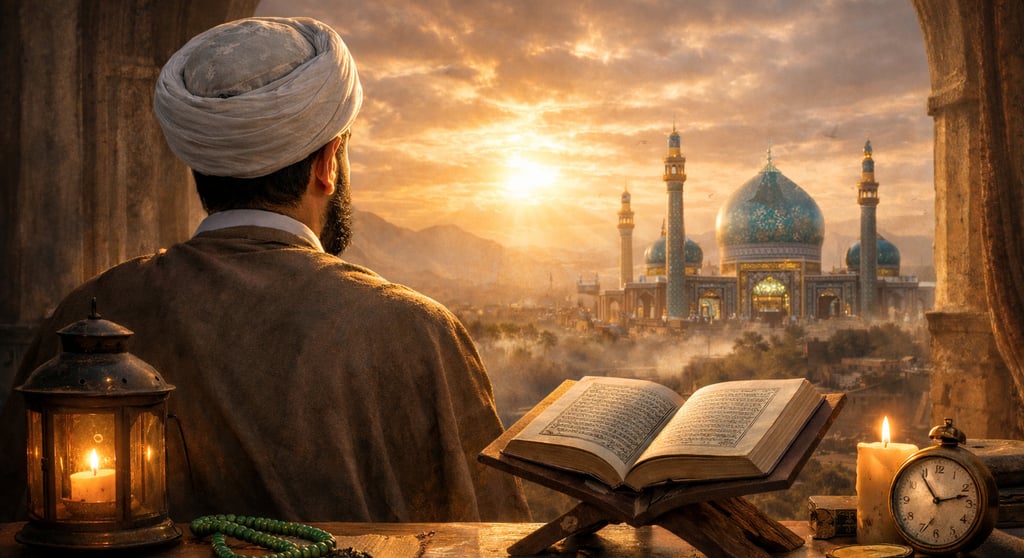
In everyday conversation, the word waiting is often associated with passivity: sitting still, doing nothing, and letting time pass. However, in Shi'a Mahdawist theology, intizhar—the act of awaiting the reappearance of Imam Mahdi—carries a far deeper meaning. It is not merely an attitude of waiting for a future event, but an ethics of life that shapes how one views oneself, society, and history.
The concept of Mahdawism indeed speaks of the future of humanity, of the establishment of universal justice under a divinely guided leader. Yet what is often overlooked is that this doctrine is not oriented solely toward the future. On the contrary, it demands readiness in the present. The promised future is not a justification for passivity, but a call for self-reform.
A narration from Imam Ja‘far al-Sadiq, recorded in Al-Ghaibah by al-Nu‘mani, strongly emphasizes the meaning of intizhar. In this narration, the Imam states that whoever wishes to be among the companions of al-Qa’im (Imam Mahdi) must await his appearance, and during that waiting must practice wara’ (moral vigilance) and makarim al-akhlaq (noble character). Even if such a person dies before the reappearance, their reward is equated with those who lived to witness it.
The message is clear: waiting is not an empty state. It is a condition filled with ethical demands.
Intizhar, therefore, becomes a kind of moral filter. Not everyone who claims love for Imam Mahdi is automatically worthy of being his supporter. What distinguishes them is whether they live as true awaiters or merely as distant admirers. Genuine waiting requires consistency between belief and way of life.
To understand the psychological dimension of intizhar, imagine someone awaiting a highly honored guest, without knowing exactly when the guest will arrive. Such a person would not act casually. They would frequently check the road, keep their phone active, clean the living space, and prepare the best hospitality. Their entire life would be marked by readiness.
This is the inner state of a muntazhir—one who truly awaits. It is a life lived in productive vigilance.
This vigilance is not limited to external events. While the awaiter remains sensitive to social, political, and moral realities, the more essential preparation occurs within. The narration highlights two main foundations: wara’ and makarim al-akhlaq. Without these, waiting becomes a contradiction. One claims to await the Imam of justice while remaining unprepared to live justly.
Here, intizhar becomes a subtle ethics of shame. Imagine inviting an honored guest yet making no preparations to receive them. When the guest finally arrives, joy is replaced by embarrassment over one’s unworthiness. This shame is existential—a realization that one is not ready.
Likewise, a person who claims to await the Imam of the Age without refining their character places themselves in an awkward position. They wait, yet do not prepare for what they await.
Within this framework, intizhar is not an escape from history. It is a conscious way of taking one’s place within it. Awaiting Imam Mahdi means living with an ongoing moral commitment, as if justice could appear at any moment and demand our readiness.
Thus, waiting no longer means silence or inactivity. It means living by higher ethical standards, sharper moral vigilance, and the awareness that each day is part of the preparation for the arrival of truth.
In the end, intizhar is not merely a theological doctrine. It is a way of life—an existential ethic in an age of waiting.